

Sports Data API Pricing Compared: Sportradar, Opta, API-Sports, SportsDataIO
Last updated: 2026-11-23
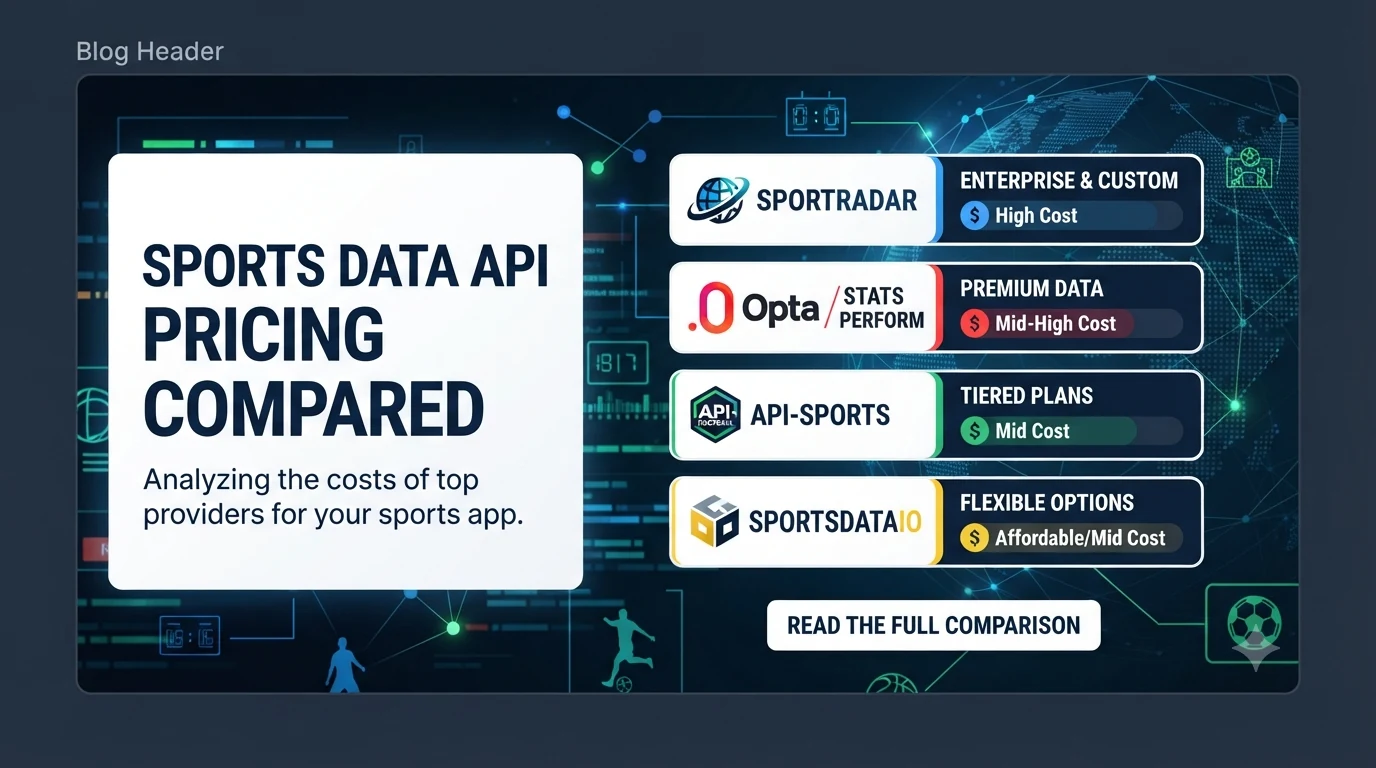
Sports data API pricing ranges from a few dollars a month for self-serve developer plans to custom annual contracts for enterprise feeds. Of the four providers fantasy founders ask about most, only API-Sports publishes plan prices; Sportradar, Opta (Stats Perform) and SportsDataIO sell production data through their sales teams.
That gap matters when you are budgeting a fantasy or prediction platform. This guide compares what each provider actually publishes, explains why most enterprise data is quote-only, and lists the costs that rarely show up on a pricing page. Every price below links to its source, and where a provider does not publish a number, we say so instead of guessing.
How does sports data API pricing work?
Sports data API pricing is usually set by four things: which leagues you need, how fast the data arrives, how many requests you make, and whether you may display the data commercially. A plan that looks cheap can be unusable for a paid fantasy product if its license only covers personal or non-commercial use.
Most providers fall into one of three models:
- Published self-serve tiers. You pick a plan on a website, pay by card and get a key. Limits are expressed as requests per day or per minute.
- Free trial, then sales. You test with a trial key, then negotiate a production license. Trials are capped by time, request quota or both.
- Quote-only enterprise licensing. There is no public price. The provider tailors a contract by competition, territory, data depth and delivery method.
If you are still deciding what data a fantasy product needs in the first place, start with our explainer on what a fantasy sports API is and how to choose one. This post focuses on cost.
What do Sportradar, Opta, API-Sports and SportsDataIO charge?
As of November 2026, API-Sports is the only one of the four with public dollar prices; the other three require a conversation with sales before you can license production data. The table below summarizes what each provider publishes about pricing, trials and limits.
| Provider | Public price | Free access | Limits published | Production access |
|---|---|---|---|---|
| Sportradar | Not published | 30-day trial | 1,000 requests per rolling 30 days, 1 query per second on trial | Reserved for Sportradar customers |
| Opta (Stats Perform) | Not published; customized quote | Demo on request | Not published | Licensed by competition, country or data level |
| API-Sports (API-Football) | Pro $19, Ultra $29, Mega $39 per month on RapidAPI | Free plan, 100 requests per day | 7,500 / 75,000 / 150,000 requests per day by tier | Self-serve subscription |
| SportsDataIO | Not published for commercial use | Free trial with scrambled data | Small daily call limit on trial | Commercial licensing through sales |
Sportradar
Sportradar offers a self-serve trial and keeps production pricing private. Its developer documentation says trials last 30 days, with a quota of 1,000 requests per rolling 30 days and 1 query per second, and that production access is reserved for Sportradar customers. Some products, such as push feeds and live odds, cannot be self-issued and require contacting sales.
The useful detail for fantasy teams: Sportradar says trial data is the same real-world data as production, with rare exceptions. That makes the trial good for validating feed structure, but 1,000 requests a month will not support a live scoring test across a full slate.
Opta (Stats Perform)
Stats Perform does not publish Opta prices. Its pricing and licensing FAQ says products and pricing are tailored to enterprise clients, that buyers should contact sales for a customized quote, and that licensing can be scoped by competition, country or data level. The same FAQ says it works with startups and smaller organizations.
Stats Perform also notes in its guide on how much sport data costs that update frequency and speed affect price. In practice, a near-live event feed will cost more than end-of-day stats for the same league.
API-Sports
API-Sports runs sport-specific APIs such as API-Football and is the most transparent of the four. Its pricing page lists a free plan at 100 requests per day and paid tiers at 7,500, 75,000 and 150,000 requests per day. The RapidAPI listing for API-Football shows those tiers at $19, $29 and $39 per month, with per-minute rate limits and per-request overage fees.
Low entry prices make API-Sports popular for prototypes and smaller launches. Before you commit, confirm the license terms for commercial display and check that the leagues and stat fields you need for scoring are covered.
SportsDataIO
SportsDataIO separates testing, hobby and commercial use. Its getting-started guide describes a free trial with instant access and no credit card, but the data is scrambled: realistic in structure, not real, and not for display. Its self-serve Discovery Lab tier offers real, next-day delayed data and is not licensed for commercial redistribution.
For a commercial fantasy product, SportsDataIO says pricing is based on use case, feeds and leagues, and its trial sign-up FAQ states that production access is only available through a commercial licensing discussion with sales.
Why is most enterprise sports data quote-only?
Enterprise sports data is quote-only because the provider’s cost depends on rights, not just bandwidth. Leagues license their data to providers by territory and use case, so a betting operator in one country and a free-to-play media game in another can need very different contracts for the same competition.
Stats Perform says this directly: it licenses by competition, country and data level. Sportradar’s documentation draws the same line between trial keys and customer-only production access. For a founder, quote-only pricing means you should expect a sales cycle, possibly a minimum commitment, and terms that differ by market.
Third-party sites publish estimated price ranges for these providers. We have left those numbers out because they come from competitors’ marketing pages and cannot be confirmed against the providers’ own materials.
Which costs should you budget for beyond the subscription?
The subscription is only part of what sports data costs a fantasy platform. Integration work, request overages, extra leagues and display rights can each change the total, so check each item below before signing.
- License scope. Does the plan allow commercial display in your target markets, and in a paid-entry product?
- League coverage. Is every competition you plan to run included, or priced as an add-on?
- Latency. Is the data live, near real time or next-day? Fantasy live scoring needs at least near real time.
- Request limits and overages. How many calls per day and per minute, and what does each extra request cost?
- Stat depth. Does the feed include every field your scoring rules use, such as assists, saves or turnovers?
- Integration effort. Who maps the provider’s IDs and fields into your contests, lineups and scoring engine?
- Contract terms. Is it monthly or annual, and is there a minimum commitment or auto-renewal?
- Support and SLA. SportsDataIO, for example, lists no SLA or dedicated support on its trial and hobby tiers.
Integration is the cost founders most often underestimate. Our comparison of white-label vs custom fantasy sports development costs covers how much of that work a ready platform removes.
How does data pricing work in Fantasy Engine?
Fantasy Engine (fantasyengine.net) offers its own Sports Data API, listed at $399 on its pricing page, already connected to the platform’s contests and scoring. It covers the EPL, LaLiga, Bundesliga, Serie A, Ligue 1, Champions League, Europa League, NBA, NFL, NHL, MLB and MMA, with golf, Formula 1 and horse racing in beta, plus pre-match odds for team sports.
Fantasy Engine is white-label fantasy sports software with eight game types, the full Laravel source code from $99, and one Expo codebase for its web, iOS and Android apps.
Here is how the data options fit the software packages:
| Option | Price | What it includes |
|---|---|---|
| Sports Data API | $399 (see pricing page for terms) | The leagues and sports listed above; live scores and stats about every minute; one live and one development key |
| Managed Infrastructure | $149/month plus $99 setup | Runs on your own VPS, with Fantasy Sports API data |
| Ultimate package | $899 one-time | Full Laravel source code plus the Expo app source code, 1 domain |
| Starter package | $99 one-time | Full Laravel source code and the ready-built web app, 1 domain; Android and iOS builds +$100 |
Because the Ultimate package includes the full Laravel backend source code and REST API, a team can also connect a provider it licenses directly, such as one of the four above, instead of using the built-in feed. The Fantasy Engine docs describe the backend and setup.
Data feeds apply to sports contests only. For politics, entertainment and custom events, admins create the events and enter the results themselves, so those contest types have no data cost. Compare the options on the Fantasy Engine data API pricing page.
Frequently asked questions
Of the four providers compared here, API-Sports has the lowest published prices, with a free plan and paid API-Football tiers listed at $19 to $39 per month on RapidAPI. Confirm the license covers commercial display and the stats your scoring needs before relying on it.
No. Sportradar offers a 30-day trial capped at 1,000 requests and 1 query per second, and says production access is reserved for its customers. Pricing comes from its sales team.
Generally no. SportsDataIO trial data is scrambled and not for display, and Sportradar trial quotas are too small for live scoring. Trials are meant for testing your integration before you license production data.
Price depends on league rights, territory, data depth, update speed and request volume. Stats Perform, for example, licenses Opta data by competition, country and data level and says faster updates affect price.
Fantasy Engine offers a Sports Data API listed at $399, covering soccer, US leagues and MMA, and its Managed Infrastructure plan includes Fantasy Sports API data. Politics, entertainment and custom events use admin-entered results.
Ready to see live data inside a working fantasy platform? Try the Fantasy Engine demo and check the scoring, contests and admin panel for yourself.