

How to Create Custom Esports Fantasy Drafts

Last updated: 2026-11-16
To create custom esports fantasy drafts, you set up a league for one game title, add its teams, players and positions, define a points value for each in-game stat, and then run draft contests on a schedule of matches you enter yourself. The hard parts are not the software but the data source, the scoring design and the rules of the game publisher and your market.
This guide walks through each step, from choosing a title to settling results. It is written for founders, agencies and media brands that want to run their own esports fantasy product instead of sending fans to someone else’s.
What are custom esports fantasy drafts?
A custom esports fantasy draft is a contest where players build a lineup of real pro gamers, one per role, and score points from those gamers’ performance in real matches. “Custom” means you, the operator, decide the title, the roster pool, the roles, the scoring and the prize structure rather than accepting a fixed format.
The model is the same as fantasy football or NBA drafts. The difference is that esports has many separate titles, each with its own roles and stats, and each run by a publisher that owns the game.
Audience size is the reason operators look at it. Esports Charts data reported by esports.gg put the League of Legends Worlds 2025 final at about 6.74 million peak viewers, just under the 2024 record of 6.86 million.
Which esports titles work best for fantasy drafts?
Titles with fixed team roles, regular league schedules and public per-player stats work best, because a draft needs clear positions and measurable output. League of Legends, Counter-Strike 2, Dota 2 and Valorant fit that pattern well.
These four are also the titles that data vendors cover most deeply. PandaScore’s developer documentation lists Counter-Strike, League of Legends, Dota 2 and Valorant as the games in its reference, with fixtures and schedules on all plans and live data on higher tiers.
| Title | Natural draft roles | Stats that score well |
|---|---|---|
| League of Legends | Top, Jungle, Mid, Bot (ADC), Support | Kills, deaths, assists, creep score, objectives |
| Dota 2 | Positions 1 to 5 (carry to hard support) | Kills, deaths, assists, last hits, tower damage |
| Valorant | Duelist, Initiator, Controller, Sentinel, Flex | Kills, deaths, first bloods, clutches, rounds won |
| Counter-Strike 2 | Entry, AWPer, Support, Lurker, IGL | Kills, deaths, headshots, opening kills, rounds won |
Role names in the table are common community labels, not official positions. Pick the set your audience already uses, and keep it consistent across contests.
How do you set up custom esports fantasy drafts, step by step?
You set up custom esports fantasy drafts in seven steps: choose a title, build the roster pool, define roles, design scoring, load the match schedule, create contests, and settle results. Work through them in order, because each step depends on the one before.
- Choose one title and one competition. Start with a single league or tournament you can follow closely. A narrow start keeps data entry and support manageable.
- Build the roster pool. Add each team and its active players. Check rosters before every match day, since substitutions are common.
- Define roles as positions. One lineup slot per role, for example five slots for a League of Legends lineup. Decide whether you allow a flex slot.
- Design the scoring. Give each stat a points value, positive or negative. See the next section for a starting table.
- Load the schedule. Group matches into rounds, such as “Week 3” or “Playoffs Day 1”, with start times in one time zone.
- Create contests. Choose the size, entry type (free or paid), single or multi entry, and the prize structure. Lock lineups at the first match start.
- Enter results and settle. After each match, enter player stats, review the standings, then complete the round so prizes are paid.
If you plan to add a salary cap, set player prices before step 6. A cap forces trade-offs between star players and value picks, which keeps lineups varied.
How should esports fantasy scoring work?
Esports fantasy scoring should reward the stats that decide matches in that title and penalize mistakes, with weights that keep every role relevant. If one role scores far more than the others, every lineup looks the same and contests lose interest.
The table below is an example starting point for League of Legends. The values are editorial suggestions, not an industry standard, so test them against a few past matches before launch.
| Stat | Example points | Why |
|---|---|---|
| Kill | +3 | Core output for carries |
| Assist | +2 | Keeps supports and junglers competitive |
| Death | -1 | Penalizes risky play without dominating the total |
| Creep score (per 10) | +0.2 | Rewards laning roles |
| Team win | +2 per player | Ties individual picks to match results |
Use this checklist before you lock a scoring sheet:
- Score a few recent matches by hand and compare the top score per role.
- Decide how best-of-three and best-of-five series count: per game or per series.
- Write a rule for remakes, forfeits and substitutes who play part of a series.
- Publish the scoring sheet on the contest page so players can check it.
- Do not change values for a contest once entries are open.
Where do you get esports data, and what do publishers allow?
You get esports data either from a commercial esports data API or by entering stats yourself from official match pages. Either way, check the game publisher’s policies before you charge entry fees or pay prizes.
Commercial feeds such as PandaScore offer fixtures, historical stats and live data through an API, which you can connect with custom development. For a small launch with a few matches a week, manual entry is often enough. Our guide to choosing a fantasy sports API covers the questions to ask any data vendor.
Publisher rules matter more in esports than in traditional sports. Riot Games’ developer policies state that a product “cannot feature betting or gambling functionality”, and they set conditions on monetization, such as offering a free tier. If you use Riot’s API or brand, read these policies in full and contact Riot through its developer portal if your model is unclear.
State law is a separate question. A 2020 National Law Review article reports that the Iowa attorney general viewed esports as a “simulated game or contest” under the state’s fantasy contest law, not as a sport under its sports wagering law. Other states may read their laws differently.
This article is not legal advice. Paid-entry contests raise licensing, tax and consumer protection questions that vary by state and country, so consult a lawyer in each market before you launch.
How do custom esports fantasy drafts work in FantasyEngine?
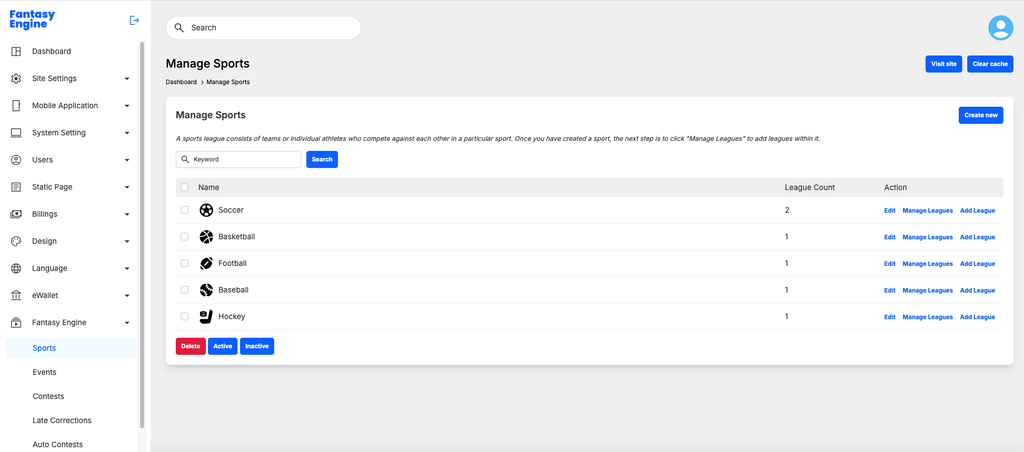
In FantasyEngine (fantasyengine.net), you run esports drafts as a custom league: the admin creates the teams, players, positions, scoring and events, and enters the results by hand. FantasyEngine is a white-label fantasy platform for sports, politics, entertainment and custom events, with full Laravel and React Native source code from $799.
The included Sports Data API covers soccer, NBA, NFL, NHL and MLB, not esports. For an esports league you either enter fixtures and stats yourself or have a developer connect your own esports feed using the source code in the Ultimate package.
Here is how the steps above map to the product:
- Game types: Draft player for lineups, and Pick winner for simple match predictions.
- Contests: single or multi entry, free or paid, with winner-take-all, top three or multi-payout prizes. Contests can be created automatically, and private contests support friend invites.
- Accounts and wallet: an e-wallet with PayPal and Stripe deposits, admin-reviewed withdrawals, identity verification before withdrawal, 2FA, age-restricted sign-up and social login.
- Apps and stack: a React web app and React Native / Expo mobile apps on a Laravel backend with a REST API.
The user guide on teams, positions, players and scoring explains how to set up a league of your own. FantasyEngine is software only: it does not run contests, and compliance, licensing and payments are the operator’s responsibility. For a broader walkthrough of draft setup, see how to create a fantasy sports draft platform with FantasyEngine.
Packages start with Starter at $79 one-time (backend source code and compiled frontend) and Ultimate at $799 one-time (full backend, web and app source code). Managed Infrastructure costs $149/month plus a $99 setup fee. Full details are on the pricing page.
Frequently asked questions
Yes. For a small schedule you can enter fixtures and player stats by hand from official match pages. A paid esports API becomes worth it once you cover many matches a week or want live scoring.
Match the number of players on a team, usually five, with one slot per role. Some operators add a flex slot or a team slot to give players more choices.
Either works, but pick one and publish it. Per-game scoring rewards players in longer series, so many operators cap or average points per series to keep contests fair.
It depends on the market, the entry model and the game publisher’s terms. Free-to-play contests carry less risk than paid entry. This is not legal advice, so consult a lawyer in each market you serve.
No. The FantasyEngine Sports Data API covers soccer, NBA, NFL, NHL and MLB. Esports leagues are set up as custom leagues where the admin enters events and results, or a developer connects your own feed.
Want to see how a draft contest looks before you plan your esports league? Try the FantasyEngine demo.