

Best White-Label Fantasy Sports Software, Compared

Last updated: 2026-11-09
The best white label fantasy sports software is the one that matches your business model: free-to-play engagement for a league or broadcaster, a full real-money platform built by an agency, or source code you own and run yourself. This guide compares four real options side by side, including FantasyEngine (fantasyengine.net), on pricing transparency, game types, code ownership and data, so you can shortlist the right vendor in one sitting.
Every vendor detail below comes from that vendor’s own public pages, linked inline. Where a vendor does not publish something, the table says so instead of guessing.
What is the best white label fantasy sports software for your business?
There is no single best product; there is a best fit for three common buyer types. A media brand that wants free fan games needs a managed engagement provider, an operator with a large budget may want a vendor-built platform, and a lean founder usually wants low-cost software with source code.
Start by naming which buyer you are. That one decision removes most vendors from your list before you book a single demo.
- Leagues, broadcasters and publishers usually want hosted free-to-play games that drive traffic and sponsorship, with the vendor running everything.
- Funded operators often want a vendor that customizes a base product, integrates payments and KYC, and supports them after launch.
- Founders and agencies often want a finished codebase they can rebrand, host and extend, with predictable one-time costs.
If you are still deciding between buying and building, read our breakdown of white label vs custom fantasy sports development first.
How do the main white-label fantasy vendors compare?
The four vendors below represent the main models on the market: managed free-to-play (FanHub), vendor-customized platform (Vinfotech), custom development agency (BR Softech) and source-code license (FantasyEngine). Only FantasyEngine and BR Softech publish price figures; the other two are quote-only.
| Criteria | FantasyEngine | Vinfotech | FanHub (Genius Sports) | BR Softech |
|---|---|---|---|---|
| Model | Software license with source code | White-label DFS platform, customized by the vendor | White-label free-to-play fan games | Development agency building white-label apps |
| Public pricing | Yes: $79 Starter, $799 Ultimate (one-time) | No, quote only; advertises a one-time setup fee | No, contact sales | Blog estimate of $6,000 to $25,000 |
| Game types | Draft player, pick winner; sports, politics, entertainment, custom events | Daily fantasy contests across many sports | Fantasy, bracket challenges, pick ’em, trivia, polling | Built to your requirements |
| Source code | Full backend, web and app code in Ultimate | Not stated on its product page | Not stated | Not stated in the cost guide |
| Mobile apps | React Native / Expo apps; Android and iOS builds +$100 on Starter | Web, iOS and Android | Not stated on its about page | Built to your requirements |
| Sports data | Optional Sports Data API, $399/month | Not priced publicly | Not stated; acquisition by Genius Sports announced in 2021 | Not priced publicly |
| Launch time claim | Depends on your own setup and hosting | “As little as 2 to 4 weeks” | Not stated | Not stated |
Here is what each vendor says about itself, in brief:
- Vinfotech says its white-label daily fantasy sports software supports cricket, soccer, basketball, baseball, rugby, kabaddi, tennis and American football. It lists payment gateway integration, automated KYC through third-party services, and web, iOS and Android apps.
- FanHub describes itself on its about page as a builder of fantasy sports, bracket challenges, pick ’em, trivia and polling games, with partners such as the NFL, NBA, MLB, MLS and FOX Sports. Genius Sports announced it would acquire FanHub in May 2021, according to Mumbrella.
- BR Softech is a development company; its white-label fantasy guide estimates white-label fantasy software at $6,000 to $25,000, and says custom builds can pass $40,000.
Treat every launch time and feature list as a vendor claim. Ask each vendor to show it working in a live demo before you sign.
What criteria should you use to compare white-label fantasy software?
Compare vendors on six things: total cost over three years, code ownership, game formats, data costs, hosting control and compliance responsibility. Features matter less than most buyers think, because most platforms cover the basics.
Use this checklist in every vendor call:
- Total cost: Ask for the setup fee, monthly fees, revenue share and the cost of each change request. A low entry price with high change fees can cost more than a higher one-time price.
- Code ownership: Do you receive the source code, or only access to a hosted product? Without code, you depend on the vendor for every fix and feature.
- Game formats: Confirm the exact contest types you need, such as salary cap, draft, pick ’em or season-long. Ask whether non-sports events are supported.
- Sports data: Is a data feed included, priced separately or your job to source? Data is often a recurring cost that buyers forget.
- Hosting and control: Who runs the servers, who holds player data, and can you move hosts later?
- Compliance: Who is responsible for licensing, age checks, KYC and payments? In most deals, it is you, the operator.
Our explainer on how white label fantasy sports software works covers each of these parts in more depth.
How much does white-label fantasy sports software cost?
Published prices range from under $100 for a source-code license to tens of thousands of dollars for an agency build, and many vendors publish no price at all. The gap reflects what you are buying: a finished codebase, a customized service, or a managed product.
BR Softech’s guide gives regional starting estimates for a basic white-label app. These are one agency’s estimates, not market averages:
| Region (per BR Softech) | Approximate starting cost |
|---|---|
| India | $6,000 to $15,000 |
| USA / Canada | $12,000 to $25,000 |
| UK / Europe | $10,000 to $22,000 |
| Middle East | $8,000 to $18,000 |
Vinfotech and FanHub require a quote, so you cannot compare them on price without contacting sales. Ask both for a written three-year estimate that includes hosting, data and support.
On top of the software, budget for hosting, a sports data feed, payment processing fees, app store accounts and legal advice in each market you enter. Licensing and compliance stay with the operator whichever vendor you pick, and this article is not legal advice, so talk to a lawyer in your market before taking paid entries.
How does FantasyEngine work as a white-label option?
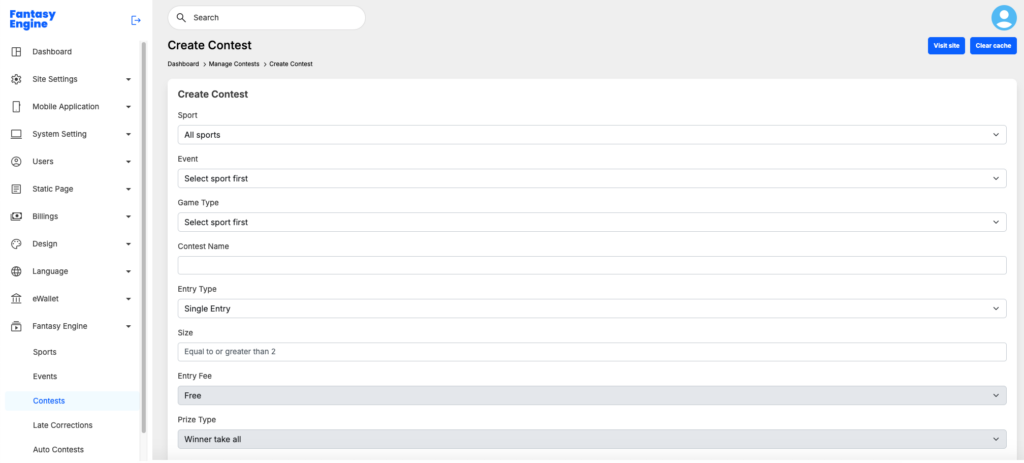
FantasyEngine is a white-label fantasy platform for sports, politics, entertainment and custom events, with full Laravel and React Native source code from $799. It is software only: it does not run contests, betting or gambling, so you operate the platform under your own brand and rules.
The FantasyEngine pricing page lists three options:
- Starter, $79 one-time: backend source code, compiled frontend, 1 domain. Android and iOS builds cost +$100.
- Ultimate, $799 one-time: full backend, web and app source code, 1 domain.
- Managed Infrastructure, $149/month plus a $99 setup fee: runs on your own server, with the data API included under fair use.
The stack is a Laravel backend with a REST API, a React web app, React Native / Expo mobile apps, MySQL or MariaDB, Redis, WebSockets through Laravel Reverb, Docker and S3-compatible storage. Your developers can follow the installation guide to set it up on your own server.
Game types today are Draft player and Pick winner. Contests can be single or multi entry, free or paid, with winner-take-all, top three or multi-payout prizes, and private contests support friend invites. For sports, the optional Sports Data API costs $399/month and covers the EPL, LaLiga, Bundesliga, Serie A, Ligue 1, Champions League, Europa League, NBA, NFL, NHL and MLB with near real-time third-party data.
For politics, entertainment and custom events, admins create the events and enter the results themselves. The wallet supports PayPal and Stripe deposits, admins review withdrawals, and players must verify their identity before withdrawing. Accounts include 2FA, age-restricted sign-up and social login.
FantasyEngine fits buyers who want to own their code and control costs. If you need a vendor to build custom formats for you, or a fully managed free-to-play service, the agency and managed options above may suit you better.
Frequently asked questions
It is a ready-made fantasy platform that you rebrand and run as your own. The vendor supplies the software, and you supply the brand, the players and the business decisions.
Among the vendors in this comparison, FantasyEngine publishes the lowest price, at $79 one-time for Starter and $799 for full source code. Vinfotech and FanHub are quote-only, so their prices cannot be compared publicly.
It depends on the vendor. FantasyEngine Ultimate includes full backend, web and app source code; other vendors in this comparison do not state code ownership on the pages we reviewed, so ask them directly.
Yes, many platforms support free contests. FanHub focuses on free-to-play games, and FantasyEngine lets you set each contest as free or paid.
Possibly, depending on your market and whether you take paid entries. This is not legal advice; licensing and compliance are the operator’s responsibility, so consult a lawyer in each market you plan to serve.
Want to see a white-label fantasy platform before you talk to sales? Try the FantasyEngine demo and test contests, the wallet and the admin panel yourself.